
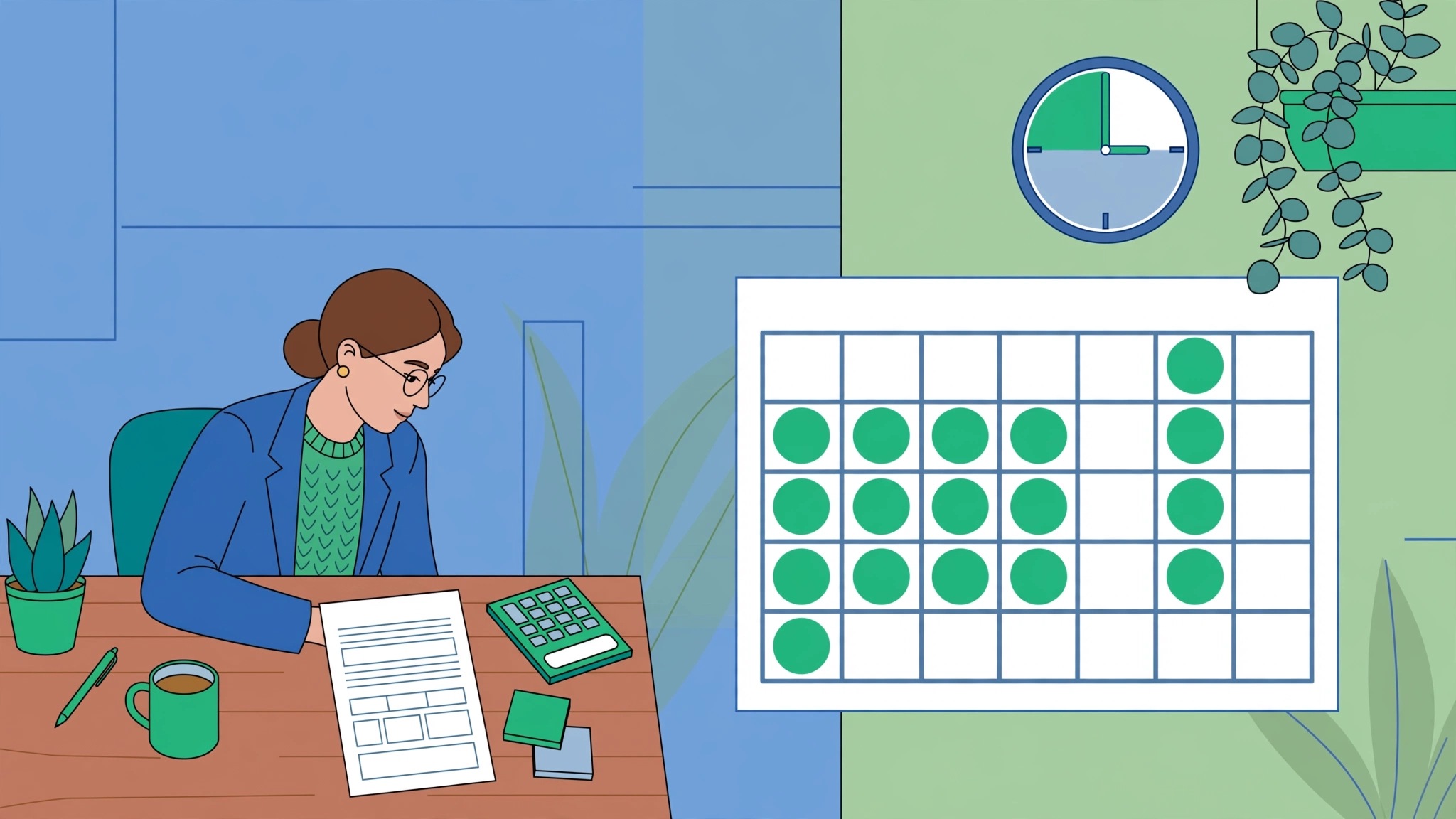
Job adverts love to quote the full-time salary in big numbers and then add two small words: pro rata. If a role is advertised at “£30,000 pro rata” and you work three days a week, you will not see £30,000. You will see £18,000, and this guide shows exactly how that figure is reached.
Pro rata is Latin for “in proportion”, and that is all it is: the full-time pay scaled down to match your hours, days or weeks. Below is the formula, worked examples for part-time and term-time contracts, and the holiday rules that sit alongside it.
QUICK ANSWER
Quick answer: Pro rata salary = full-time salary × (your hours ÷ full-time hours). Example: a £30,000 full-time salary worked at 22.5 hours of a 37.5-hour week pays £18,000 a year, or £1,500 a month. Working set days instead of hours? Swap hours for days and the maths is identical. On a term-time contract, multiply once more by (weeks worked ÷ 52).
In this guide
The Pro Rata Formula, Step by Step
You only need four steps:
- Find the full-time equivalent (FTE) salary. This is the figure in the advert or your contract, for the full-time version of the job.
- Find the full-time hours for that job. This is usually 37.5 or 40 hours a week, but check your contract, because it changes the answer.
- Divide your hours by the full-time hours. Working 22.5 hours against a 37.5-hour week gives 0.6, or 60 percent.
- Multiply the FTE salary by that fraction. £30,000 × 0.6 = £18,000.
If you work set days rather than set hours, use days in the same formula: a £30,000 role worked over 3 days of a 5-day week is £30,000 × (3 ÷ 5) = £18,000. Both routes land on the same figure as long as your days are all the same length. If you would rather skip the arithmetic, our pro rata salary calculator does all four steps for you: pro rata salary calculator
Worked Example: £30,000 Full-Time, 22.5 Hours a Week
This is the most common pattern we see: a full-time job at 37.5 hours, taken on at three days a week.
| Part of the calculation | Figure |
|---|---|
| Full-time equivalent salary | £30,000 a year |
| Full-time hours | 37.5 a week |
| Your hours | 22.5 a week |
| Your fraction of full-time | 60 percent |
| Your pro rata salary | £18,000 a year |
| Per month | £1,500 |
| Per week | £346.15 |
One point worth knowing: your hourly rate does not change. £30,000 over a 37.5-hour week is £15.38 an hour, and £18,000 over 22.5 hours is the same £15.38 an hour. Pro rata changes how many hours you are paid for, never the rate itself. If an offer letter shows a lower hourly rate than the full-time role, that is not pro rata, it is a different rate of pay.
What Common Salaries Look Like Pro Rata
The table below uses a 37.5-hour full-time week. Find your full-time salary, then read across to your hours.
| Full-time salary | 37.5 hours | 30 hours | 25 hours | 22.5 hours | 18.75 hours |
|---|---|---|---|---|---|
| £25,000 | £25,000 | £20,000 | £16,667 | £15,000 | £12,500 |
| £30,000 | £30,000 | £24,000 | £20,000 | £18,000 | £15,000 |
| £40,000 | £40,000 | £32,000 | £26,667 | £24,000 | £20,000 |
Term-Time and Part-Year Contracts
Term-time contracts, common in schools, add a second step because you work fewer weeks as well as, sometimes, fewer hours:
Term-time salary = full-time salary × (your hours ÷ full-time hours) × (your weeks ÷ 52)
Take a teaching assistant role with a £26,000 full-time salary. The hours are full-time at 37.5 a week, so the hours fraction is 1, but the job runs for 39 term weeks only: £26,000 × (39 ÷ 52) = £19,500 a year. Most term-time staff are still paid in twelve equal monthly instalments (£1,625 a month here), so the pay feels like a normal salary even though the work happens in term weeks.
Read your contract carefully on one point: many term-time contracts add your holiday entitlement on top of the term weeks, so the weeks you are paid for can be higher than the weeks you actually work. Use the paid-weeks figure from your contract in the formula, not just the term weeks.
Work out your own numbers
Our free pro rata salary calculator handles hours, days and term-time contracts, and breaks the result down by year, month, week and hour.
Use the pro rata salary calculatorPro Rata Holiday Entitlement
Holiday scales down in exactly the same proportion. Almost every worker is entitled to at least 5.6 weeks of paid holiday a year. If you work set days each week, your entitlement is simply 5.6 multiplied by your days:
| Days worked per week | Statutory holiday entitlement |
|---|---|
| 5 days | 28 days |
| 4 days | 22.4 days |
| 3 days | 16.8 days |
| 2 days | 11.2 days |
| 1 day | 5.6 days |
That entitlement usually has to absorb bank holidays that fall on your working days, so check how your employer treats them. The GOV.UK guide to holiday entitlement rights explains the rules in full, and there is an official calculator for less standard patterns.
If your hours are irregular, or you only work part of the year, the rules changed recently. For leave years beginning on or after 1 April 2024, holiday builds up at 12.07 percent of the hours you work in each pay period. That percentage comes from the 5.6 statutory weeks measured against the 46.4 working weeks in a year. Employers of irregular-hours and part-year staff can also pay holiday pay as a 12.07 percent uplift on each payslip, called rolled-up holiday pay, instead of paying it when you take leave. It must be shown as its own line on the payslip if they do.
Tax and National Insurance on a Pro Rata Salary
There is no special tax treatment for pro rata pay. Your salary is taxed like any other salary, through PAYE, and National Insurance is worked out on what you are actually paid in each pay period. One advantage works in your favour: the tax-free personal allowance (£12,570 for 2026/27) is the same whether you work full-time or part-time, so a bigger slice of a part-time salary escapes tax altogether, and lower pay can fall below the National Insurance thresholds entirely. To see the deductions on your own figures, try our National Insurance calculator.
Frequently Asked Questions
Method checked against GOV.UK holiday entitlement guidance; tax figures for 2026/27. This guide is general information, not financial advice. For your own figures, use the pro rata salary calculator.
Leave a Reply