
If you have ever typed “how much inheritance tax will I pay” into Google, you are not alone. It is one of the most searched tax questions in the UK, and the answer is less complicated than most people expect. Once you know the three key numbers, you can work out an estimate on the back of an envelope.
This guide walks you through exactly how to calculate inheritance tax in the UK for the 2026/27 tax year, with worked examples for both single people and married couples. If you would rather skip the maths, our free inheritance tax calculator does it for you in seconds.
In this guide
- The Three Numbers That Decide Everything
- How to Work Out Inheritance Tax, Step by Step
- Worked Example 1: Single Person (£600,000 Estate)
- Worked Example 2: Married Couple (£900,000 Estate)
- How Much Inheritance Tax Will I Pay?
- What Counts Towards the Estate?
- Try It with Your Own Numbers
- Frequently Asked Questions
The Three Numbers That Decide Everything
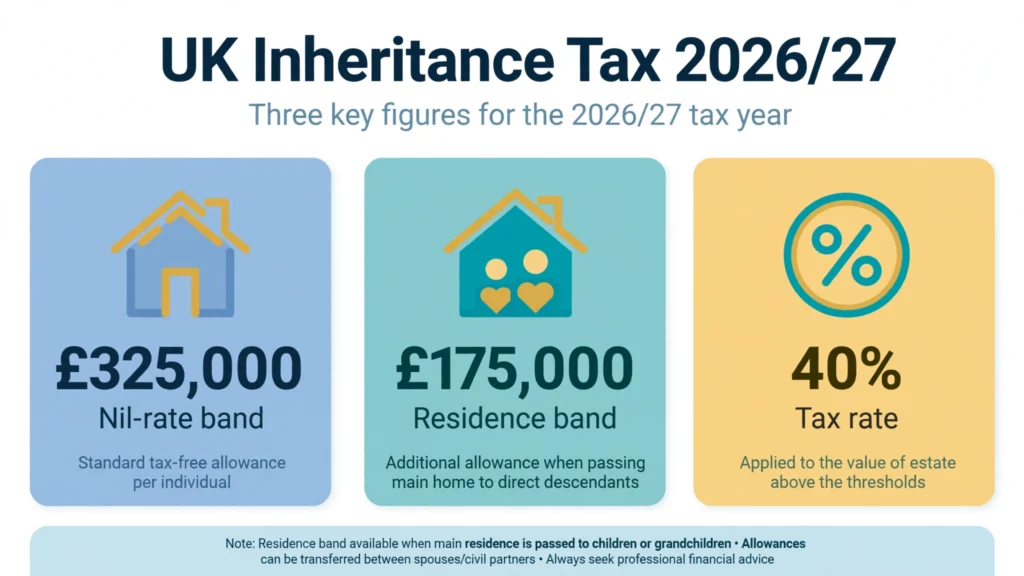
Inheritance tax (IHT) is charged at a flat 40% on the part of an estate that sits above the tax-free allowances. For 2026/27, those allowances are:
| Allowance | Amount (2026/27) |
|---|---|
| Nil-rate band | £325,000 |
| Residence nil-rate band | £175,000 |
| Combined maximum for one person | £500,000 |
Both allowances have been frozen until April 2031, so these figures are not changing any time soon. The government’s own guidance confirms the current thresholds on GOV.UK’s inheritance tax pages.
The nil-rate band applies to everyone. The residence nil-rate band is extra, but only if you leave your home (or a share of it) to direct descendants such as children or grandchildren.
How to Work Out Inheritance Tax, Step by Step
Here is the method HMRC effectively uses, simplified into four steps:
Step 1. Add up the estate. That means property, savings, investments, and personal belongings, minus any debts and funeral costs.
Step 2. Subtract the nil-rate band (£325,000). If the estate is worth less than this, there is usually no inheritance tax to pay at all.
Step 3. Subtract the residence nil-rate band (£175,000) if a home is being left to children or grandchildren.
Step 4. Apply 40% to whatever is left. That is the inheritance tax bill.
Worked Example 1: A Single Person with a £600,000 Estate
Sarah owns a flat worth £420,000, has £180,000 in savings and investments, and no debts. She leaves everything to her two children.
| Step | Calculation | Amount |
|---|---|---|
| Total estate | £420,000 + £180,000 | £600,000 |
| Minus nil-rate band | £600,000 – £325,000 | £275,000 |
| Minus residence nil-rate band | £275,000 – £175,000 | £100,000 |
| Tax at 40% | £100,000 x 40% | £40,000 |
WORKED EXAMPLE 1 RESULT
£40,000 inheritance tax
On a £600,000 estate left to children
So on a £600,000 estate, the inheritance tax bill comes to £40,000.
Worked Example 2: A Married Couple with a £900,000 Estate
Married couples and civil partners get a significant advantage: any unused allowance transfers to the surviving partner. If the first partner leaves everything to the other, the survivor can effectively double both allowances.
That means a married couple can pass on up to £1,000,000 tax-free (£500,000 each) when a home goes to their children.
Take a couple with a combined estate of £900,000, including the family home left to their children:
| Step | Calculation | Amount |
|---|---|---|
| Total estate | Combined assets | £900,000 |
| Minus combined nil-rate band | £900,000 – £650,000 | £250,000 |
| Minus combined residence band | £250,000 – £350,000 | £0 |
| Tax at 40% | Nothing above allowances | £0 |
WORKED EXAMPLE 2 RESULT
£0 inheritance tax
On a £900,000 estate — fully covered by the married couple’s combined £1,000,000 allowance
No inheritance tax is due, because the full £900,000 sits within the couple’s combined £1,000,000 allowance.
How Much Inheritance Tax Will I Pay?
Here are quick answers for common estate sizes, assuming a single person with the full £325,000 nil-rate band and £175,000 residence nil-rate band.
| Estate Size | Taxable Amount | Inheritance Tax Due |
|---|---|---|
| £500,000 | £0 | £0 |
| £700,000 | £200,000 | £80,000 |
| £1,000,000 | £500,000 | £200,000 |
What Counts Towards the Estate?
Not everything you own is counted the same way. Here is a quick reference:
| Usually included | Usually excluded |
|---|---|
| Your home and other property | Gifts made more than 7 years before death |
| Bank accounts and savings | Life insurance written in trust |
| Stocks, shares and investments | Some business and agricultural assets (reliefs apply) |
| Cars, jewellery and valuables | Pension pots (usually outside the estate) |
Gifts are the area that trips most people up. Anything you give away within seven years of death may still count, on a sliding scale called taper relief. GOV.UK explains the seven-year rule for gifts in detail.
Try It with Your Own Numbers
Reading examples is useful, but nothing beats running your own figures. Our free inheritance tax calculator uses the same 2026/27 rates shown above. Enter your estate value, tick whether a home is included, and it shows the full breakdown instantly. No sign-up, no email, just the answer.
Try it with your own numbers
Enter your estate value and see your exact inheritance tax bill in seconds. Free, no sign-up.
Use the free inheritance tax calculatorFrequently Asked Questions
Figures in this guide reflect the 2026/27 tax year. Tax rules change, so check GOV.UK for the latest position, and consider professional advice for large or complex estates.
Leave a Reply